

Quick Summary
When you are arrested in New Jersey for an indictable offense, the New Jersey felony case process determines whether you remain in custody or are released while your case moves toward a possible indictment.
Felony charges New Jersey, legally referred to as indictable offenses, follow a structured legal process that includes several stages before a case proceeds to trial. The process generally begins with an arrest and an initial court appearance. From there, the case moves through procedures such as a bail hearing, evidence review, and potential pretrial motions.
Before a case can formally move forward, it is typically presented to a grand jury to determine whether an indictment should be issued.
New Jersey Criminal Defense Attorneys can explain how each stage works and what options may be available as the case progresses.
Felony Offense Defined Under New Jersey Law
A felony, or indictable offense, in New Jersey is any crime punishable by imprisonment of more than one year. These are the state’s most serious offenses, distinguished from disorderly persons offenses by their severity and long-term consequences.
Convictions for these crimes can have lasting effects on an individual’s personal and professional life.
Types of Conduct That Lead to Indictment
Indictable offenses in New Jersey cover a wide range of criminal conduct. These charges are typically associated with more serious allegations that involve harm to individuals, property, or public safety.
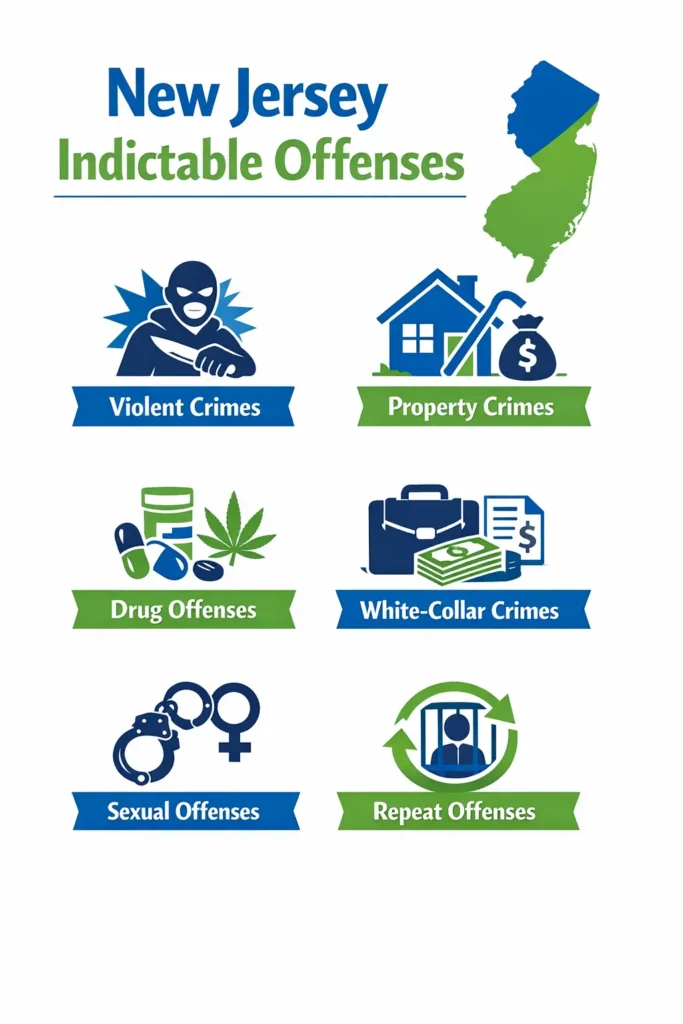
- Violent offenses such as homicide, robbery, and kidnapping
- Sexual offenses such as rape, coercion, use of force, and sexual abuse of a minor
- Drug-related offenses such as manufacturing, distribution, or possession
- Property-related offenses such as burglary, arson, and high-value theft
- White-collar offenses such as fraud, embezzlement, and identity theft
- Repeat offenses, such as prior convictions, that result in enhanced charges
These offenses are further classified into four degrees:
Degree of Offense | Overview |
First-degree | Most serious; generally 10–20 years imprisonment and up to $200,000 fine |
Second-degree | Serious; generally 5–10 years imprisonment and up to $150,000 fine |
Third-degree | Moderate; generally 3–5 years imprisonment and up to $15,000 fine |
Fourth-degree | Least severe; up to 18 months imprisonment and up to $10,000 fine |
The degree of the offense determines potential imprisonment, fines, and the course the case takes through the criminal justice system.
The New Jersey Criminal Process in Depth
The felony case process NJ begins long before trial, following a defined sequence within the criminal justice system. Each stage ensures that legal rights are protected and that the case progresses within statutory timelines.
Arrest And Booking Initiated By Police
Once a suspect is identified, law enforcement formally initiates the case. Depending on the circumstances, the individual may be taken into custody or issued a summons to appear in court at a later date.
If taken into custody, booking procedures record personal information, capture fingerprints and photographs, and establish an official record of the arrest.
Initial Court Appearance And Judicial Review
Following an arrest, individuals typically appear in court within a short timeframe. At this hearing, the judge reviews basic case details, confirms legal representation, and schedules upcoming hearings.
While issues such as pretrial release may also be addressed, the main purpose of this step is to bring the case before the court and ensure it proceeds on schedule.
Defense Review And Case Preparation Stage
During this stage, defense attorneys collect and review evidence related to the charges. Requests for documents, reports, and other information help both sides understand the scope of the case.
Early review allows the defense to identify legal issues, prepare pretrial motions, and evaluate whether alternative programs or resolutions may apply before indictment or trial.
Pre-Indictment Discussions And Resolution Options
Before a formal indictment, prosecutors and defense counsel may hold preliminary discussions to assess the charges, review limited evidence, and explore potential resolutions.
Possible outcomes include adjustments to charge severity or consideration for diversion programs, though any decisions remain subject to court approval.
Grand Jury Evaluation And Indictment Decision
Most felony cases advance to grand jury review. Citizens examine the prosecution’s evidence to determine whether sufficient cause exists for formal charges.
A “true bill” results in a formal indictment, while a “no bill” can lead to dismissal or reduced charges. This stage ensures the case is ready to proceed to Superior Court.
Arraignment And Entry Of Plea
After indictment, an arraignment is scheduled at which the charges are formally presented and a plea is entered. The court also addresses procedural matters, such as the status of discovery, and sets timelines for future hearings.
The primary purpose of an arraignment is to formally present the charges and record a plea.
Pretrial Motions And Legal Challenges Filed
Following the arraignment, defense attorneys may file motions to challenge evidence or limit certain proceedings. Common motions request suppression of evidence, exclusion of testimony, or dismissal based on procedural issues.
These motions help define the trial’s scope, allow legal arguments to be considered in advance, and influence strategy and potential outcomes.
Trial Proceedings And Case Evidence Presentation
If a plea agreement is not reached, the case proceeds to trial. Evidence is presented, witnesses are examined, and both sides make arguments.
The trial ensures fairness, allows cross-examination, and provides the judge or jury with the information needed to reach a verdict in accordance with the applicable legal standard of proof.
Sentencing And Post-Conviction Considerations
Following a guilty verdict or accepted plea, the court proceeds with sentencing. Judges consider factors such as offense severity, prior record, and statutory guidelines.
Sentences may include imprisonment, fines, restitution, probation, or alternative programs. While sentencing concludes the primary judicial process, appeals or post-conviction actions may follow.
Possible Long-term Implications for the Accused
Felony charges in New Jersey can lead to legal and administrative obligations that continue even after a case concludes. Certain professional licenses may be suspended or revoked depending on the offense. Housing applications, loan approvals, and employment screenings may also involve background checks that reflect criminal convictions. In addition, financial penalties such as fines, restitution, or court fees may remain in place long after sentencing.
Individuals may also be required to comply with probation or parole conditions set by the court. These conditions can include reporting requirements, community service, or participation in monitoring programs. Such requirements may affect personal planning, professional activities, and everyday responsibilities.
Final Perspective on Felony Charges in New Jersey
In New Jersey, felony-level crimes are prosecuted as indictable offenses and move through a defined court process once charges are filed. After an arrest, the case enters the court system, beginning with early hearings that address custody status and inform the accused of the allegations. Certain felony charges New Jersey may be dismissed before trial through negotiated resolutions, while others continue to a full court hearing.
Before the case can proceed to trial, prosecutors must present their evidence to a grand jury, which determines whether there are sufficient grounds to indict. If an indictment is returned, the case advances to arraignment, where a plea is entered, and the court sets a schedule for further proceedings. Pretrial filings may follow to address evidentiary questions.
Throughout this process, statutes and court rules govern how cases proceed, the timelines involved, and the legal rights that apply at each stage. New Jersey Criminal Defense Attorneys can provide professional guidance. You may Contact Us or call (973) 755-9093.
Frequently Asked Questions
Can someone charged with armed robbery in New Jersey be released before trial?
Pretrial release depends on the severity of the indictable offense, prior convictions, and risk factors. Courts may set bail, issue a summons, or impose conditions like electronic monitoring. Compliance with these rules is required, and violations can affect release status and the progression of the case even before formal hearings.
How can a drug distribution charge affect immigration status in New Jersey?
For non-citizens facing felony charges New Jersey, such as drug distribution, they may face detention, visa revocation, or deportation. The impact depends on offense details, plea decisions, and current immigration status. Legal guidance is essential because court outcomes can directly influence residency, work authorization, and eligibility for permanent status or citizenship.
Are there special rules for juveniles charged with assault in New Jersey?
Juveniles charged with an indictable offense, such as assault, are generally processed in Family Court, which focuses on rehabilitation over punishment. Certain offenses may transfer to adult court. Hearings are confidential, detention facilities are separate, and legal representation is specialized. This approach balances accountability with age-appropriate intervention to reduce long-term consequences.
